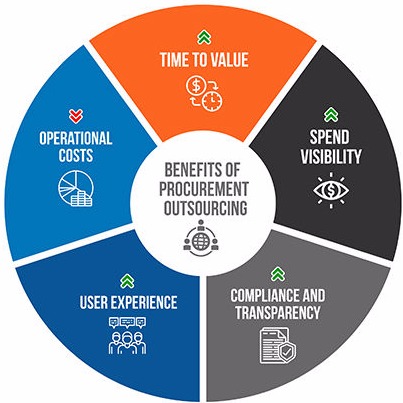
Team NADE has consistently been a trusted service provider in offering procurement as-a-service. With a strong vision for the future of procurement, paired with deep procurement knowledge and capabilities, NADE delivers transformational procurement value to its clients.
A study estimates that a procurement outsourcing engagement spanning the entire source-to-pay process can address a cost base that could represent 5 to 15 percent of an organization’s overall revenues. (Most other BPO segments typically impact less than 1 percent of overall revenues.)
Procurement outsourcing impacts procurement spend as well as the operational costs that are addressed by other forms of business process outsourcing, so the rewards can potentially be much richer.
The potential bottom-line impact that procurement outsourcing can create is higher. On average, organizations that outsourced procurement realized 5 to 10 percent savings on their outsourced procurement spend. With so much at stake, the best way to move forward is to take full advantage of procurement outsourcing.
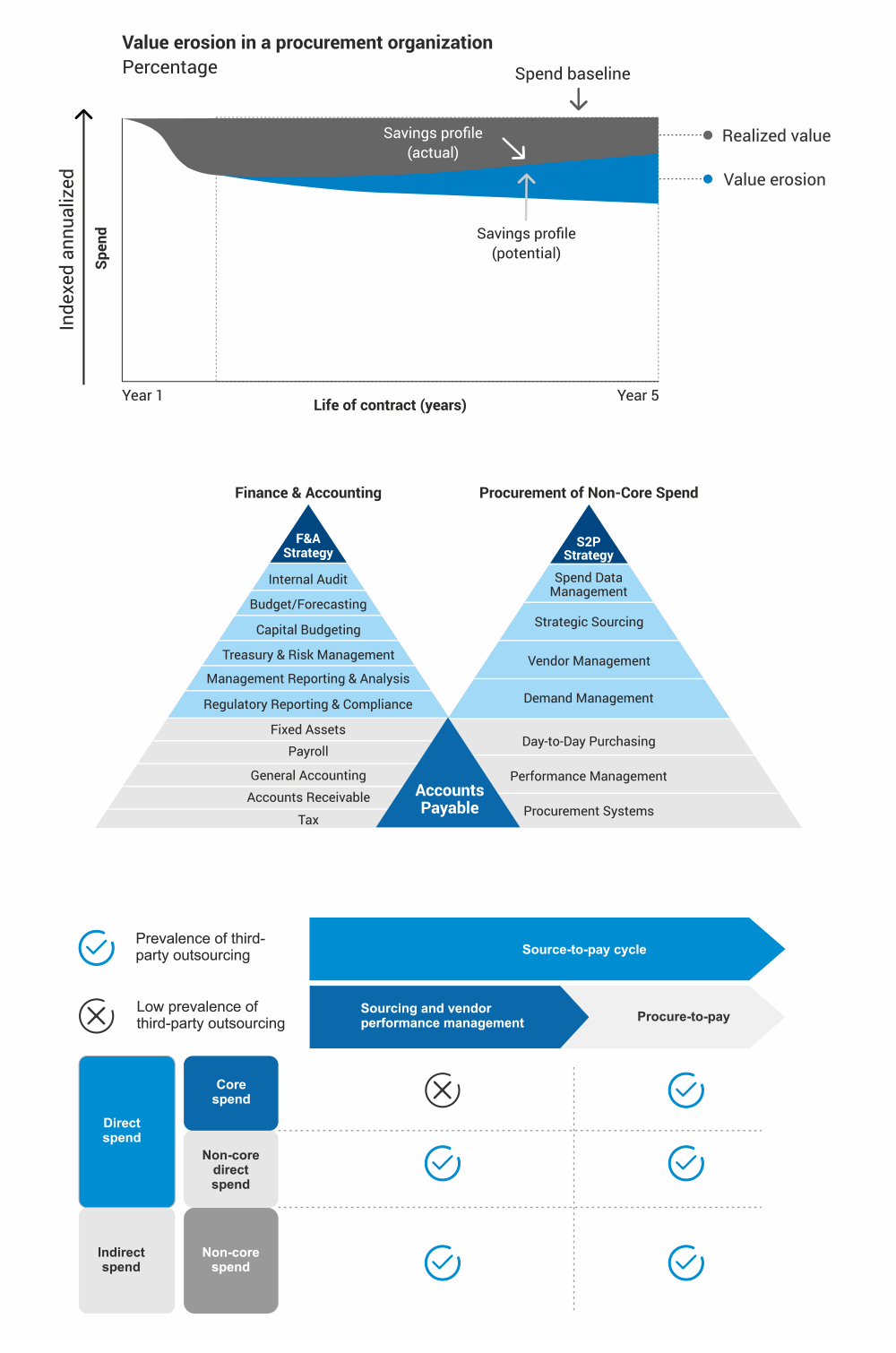
Procurement outsourcing contracts have typically been focused on a few activities within procure-to-pay (P2P) operations or within sourcing and category management. Fewer procurement outsourcing contracts take an end-to-end, source-to-pay (S2P) approach. P2P-focused contracts deliver operational efficiency, while source-to-contract (S2C)-focused contracts can deliver unit-price reduction. However, the lack of integration between upstream and downstream processes often results in significant savings leakage. For example, non-compliance in the P2P process erodes the value generated in the S2C process.
To ensure targeted savings are fully realized, there must be a tight linkage between sourcing and finance teams to ensure that contracted savings get driven to the bottom line by adjusting budgets. Without this close partnership, sourcing savings are not fully realized, as budget holders most often spend these savings and consume their full budgets, rather than selectively reinvesting them where they can have the greatest impact on shareholder returns.
Additionally, FAO and PO have a clear overlap around the accounts payable (AP) function. PO is heavily dependent on efficiency and compliance in the AP process to derive savings.
Significant value created in a PO engagement can be eroded by maverick spend, duplicate payments, and poor working capital management. It's critical to have finance involved in the PO initiative right from the beginning, along with sourcing and procurement, to ensure smooth transitions across the two functions. See picture 1.
CFO-level involvement can often help accelerate and increase savings, particularly within areas of the business where procurement has not traditionally been heavily involved, such as marketing and legal functions. CFOs can be particularly influential here in brokering these partnerships and ensuring that the domain expertise of the service provider is fully leveraged so that all high-spend areas are well managed and supported by procurement. Lastly, additional benefits to finance from active involvement with procurement include improved information and data, as finance is dependent on inputs from procurement. More streamlined and integrated processes and data can help reduce the processing time and effort of the finance function, which in turn can lead to savings from AP headcount reduction.
There are multiple nomenclatures to classify procurement spend. The most common has been the differentiation of direct versus indirect spend, with the premise that PO typically applies to indirect spend, while direct spend is strategic and needs to be managed internally. However, with maturity of the PO market, and the need to drive bottom-line impact in a tough economic scenario, PO is encroaching on traditional direct spend areas through P2P outsourcing, tail-spend management and specific categories such as packaging, bundled services, and MRO. Also, while the classification of direct versus indirect spend makes sense in a manufacturing, it has less relevance to service-oriented sectors such as telecom, hospitality, and financial services. See picture 2.
In the current state, where service-oriented sectors are also leading adopters of procurement outsourcing, it makes more sense to classify spend as core versus non-core, rather than direct versus indirect. All spend that can be outsourced, including all indirect categories and non-core direct categories, such as MRO, can be classified as non-core spend.
As discussed earlier, the procurement outsourcing value proposition is fairly complex, and hence buyers need to take a phased approach to manage risk. However, it is equally important to have a long-term vision and not focus on short-term benefits that can erode with time or lead to severely limited options in the future, when the client has a clear need to expand the procurement outsourcing scope. It’s fine to start the engagement with just parts of the P2P or S2P function or with certain categories to build trust and create a comfortable working relationship between the buyer and service provider. However, the buyers need to have a long-term vision of how to develop a scalable model for the entire S2P cycle covering all non-core categories. Buyers need to have a strategic vision with regard to centralization, adoption of sourcing models, technology and process transformation, and organizational changes to create an integrated and streamlined S2P cycle.
Unit price reduction drives the largest quantum of value in a procurement outsourcing engagement, followed by spend compliance and operational efficiency. Unit price reduction, which includes savings derived from the S2P process through competitive bidding, global sourcing, contract negotiation, supplier consolidation, demand management and SKU rationalization, accounts for 40 to 60 percent of savings in PO. However, an aspect that most buyers fail to grasp is the importance of spend compliance. Compliance drives another 30 to 50 percent of realized savings. A strong governance structure, with equal participation from the buyer and service provider, needs to be put in place to promote compliance and prevent savings leakage through maverick spending, budgetary and demand issues, and vendor non-compliance. Operational efficiency savings are driven by more standardized and rationalized processes, accounting for reduced time and effort, leading to savings through headcount rationalization and labor arbitrage, and operational benefits like reduced duplicate payments, Early Payment Discount (EPD) capture, and working capital improvements. See picture 3.
NADE offers the perfect blend of strategic and advisory services, pace-setting technology and managed services, with a laser focus on procurement and supply chain transformation to help clients achieve their business goals.
Spend Analysis
Strategic Sourcing
Category Management
Sourcing Support
Tail-Spend Management
Transactions Management
Contract Management
Sourcing Process Management
Tracking & Compliance
With deep expertise in procurement transformation, we guide enterprise procurement teams toward a new operating model — one where strategy, technology and operations combine to deliver game-changing business outcomes.
Procurement’s role in the enterprise has evolved. Today, CPOs and procurement leaders are expected to work closely with the C-suite as strategic business partners and trusted advisors to mitigate risks, create competitive advantage, and drive enterprise growth.
Global enterprises tend to build and manage high-performance procurement organizations to rapidly achieve more efficient, more effective operations, with greater strategic reach and increased business impact.
Team NADE can help advise clients across their procurement platform and is adept at bringing to bear its category and transformation expertise to help them achieve their organizational, supply management, and process efficiency objectives.
Team NADE is helping organizations be successful by diagnosing our spending patterns and working with them to develop new business processes and practices that will save millions of dollars that can be channeled back to their core missions.
NADE's strategic cost management services enable leadership teams to reduce expenses in categories that yield little impact, and optimize spend in areas that drive sustainable growth. Our strategic cost management programs can help identify and eliminate up to 35 percent of SG&A expenses within a year.
NADE combines supply chain acumen with deep knowledge of industry-specific procurement practices and suppliers, reflecting its strong sourcing and procurement heritage. This helps clients balance opportunity with risk as they evaluate, rationalize, and optimize their supplier ecosystems.
NADE adopts a holistic approach toward procurement transformation that focuses on building a high-performance procurement organization in the shortest period of time.
We differentiate ourselves by supporting our clients throughout the transformation journey. In our engagements, we typically run a parallel track of strategic sourcing to help our clients deliver lasting financial results while they build internal capabilities. As with any transformation program, the real challenge is in the implementation. We follow a tried & tested step-by-step guide to solve this challenge.